Aqueous Solution Characteristics
Low Foaming
Due to its molecular structure, Nichigo G-Polymer™ has excellent low foaming characteristics in aqueous solutions.
Aqueous solutions with excellent workability can be achieved without adding antifoaming agent.
Foaming comparison with PVOH
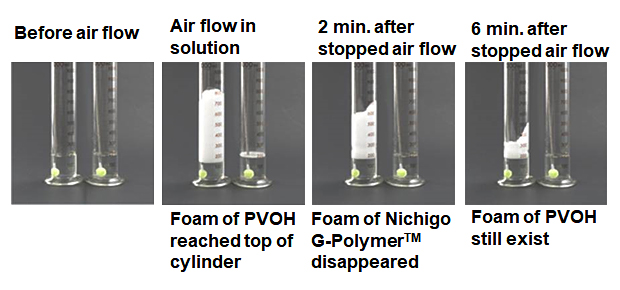
Right: Nichigo G-Polymer™ (fully saponified)
Left: PVOH (fully saponified)
[Test method]
Add a 1% aqueous solution (200 mL) into a 1L graduated cylinder, blow in 300 cc/min of air through a sparger, and observe the height of the foam over time.
Storage stability of aqueous solution at low temperatures
Aqueous solutions of Nichigo G-Polymer™ demonstrate excellent viscosity stability when stored at low temperatures.
By controlling crystallinity, the viscosity of the aqueous solution can also be controlled.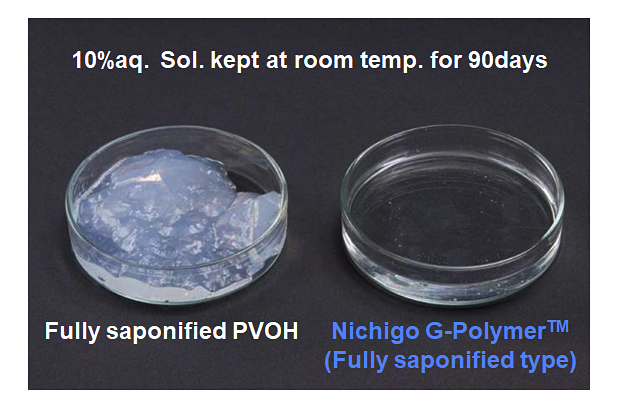
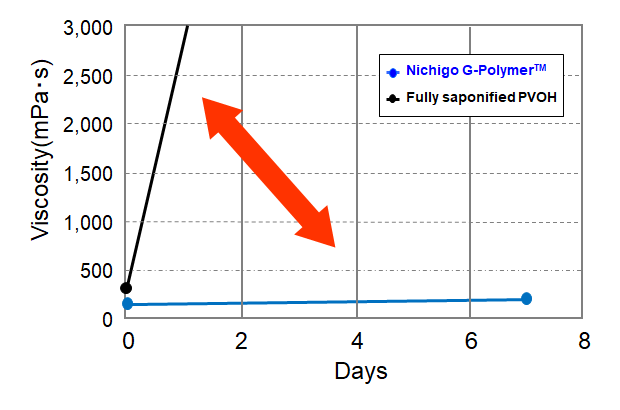
Nichigo G-Polymer™: fully saponified
10% aqueous solution stored at 5°C, viscosity measurement: Brookfield viscometer, 10 rpm
Viscosity stability under high shear conditions
Nichigo G-Polymer™ aqueous solution exhibits resistance to the occurrence of flow abnormalities even under high shear conditions.
Therefore, application to high-speed coating and other purposes is expected.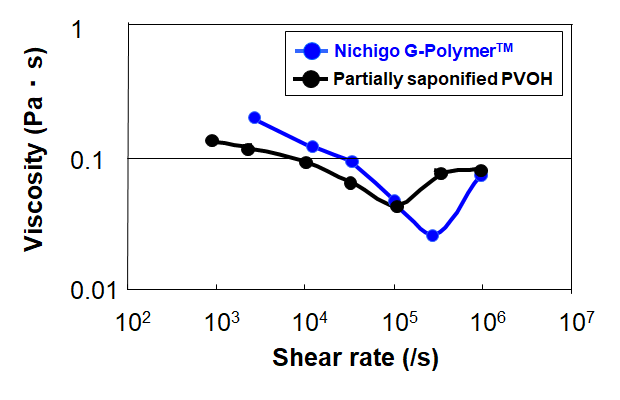
Partially saponified PVOH, degree of saponification: 88 mol%
[Measurement]
Capillary rheometer, 7.5% aqueous solution
Stability in alkaline aqueous solutions
Nichigo G-Polymer™ is stable and resists changes in viscosity even in highly concentrated alkaline aqueous solutions.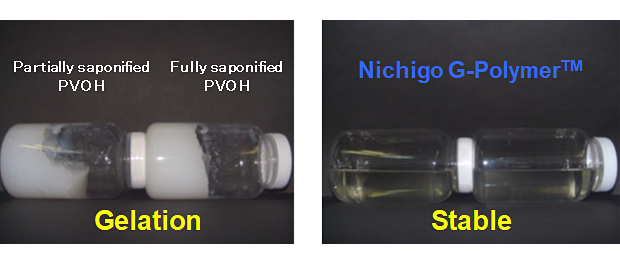
[Test method]
Mix 12% resin aqueous solution and 20% NaOH aqueous solution 1:1.
Observe the solution state after leaving at 23°C for 3 days.
Dissolution state when dissolving each resin in 10% NaOH aqueous solution
| Samples | Just after dissolved | After 1 day | After 1 week |
| Nichigo G-Polymer™ AZF8035Q | Dissolve | Dissolve | Dissolve |
| Partially saponified PVOH | Partially dissolve | Gelation | Gelation |
| Fully saponified PVOH | Partially dissolve | Gelation | Gelation |
[Conditions]
Polymer concentration: 6%
Dissolution condition : 90°C, 1 hr
Storage temperature : 40°C
Viscosity was measured at different pHs when stored at 5°C and at 23°C.
Fully saponified PVOH stored at 5°C formed a gel in one day.
In contrast, the viscosity of Nichigo G-Polymer™ remained stable regardless of pH.
Viscosity stability of aqueous solutions over time
| Samples | pH | Viscosity of aqueous solution (mPa・s) | |||
| 5℃ | 23℃ | ||||
| Initial | 1 month later | Initial | 1 month later | ||
| Nichigo G-Polymer™ | 3.0 | 170 | 170 | 110 | 110 |
| 8.0 | 170 | 180 | 110 | 110 | |
| 13.0 | 160 | 180 | 110 | 110 | |
| Fully saponified PVOH | 3.0 | 200 | Gelation | 120 | 130 |
| 8.0 | 190 | Gelation | 120 | 130 | |
| 13.0 | 230 | Gelation | 120 | 140 | |
[Test method]
Measured the viscosity of a 7% aqueous solution at a pH adjusted to 3.0 with 10% acetic acid aqueous solution and to 8.0 and 13.0 with 10% NaOH aqueous solution, after storage at 5°C and 25°C for one month
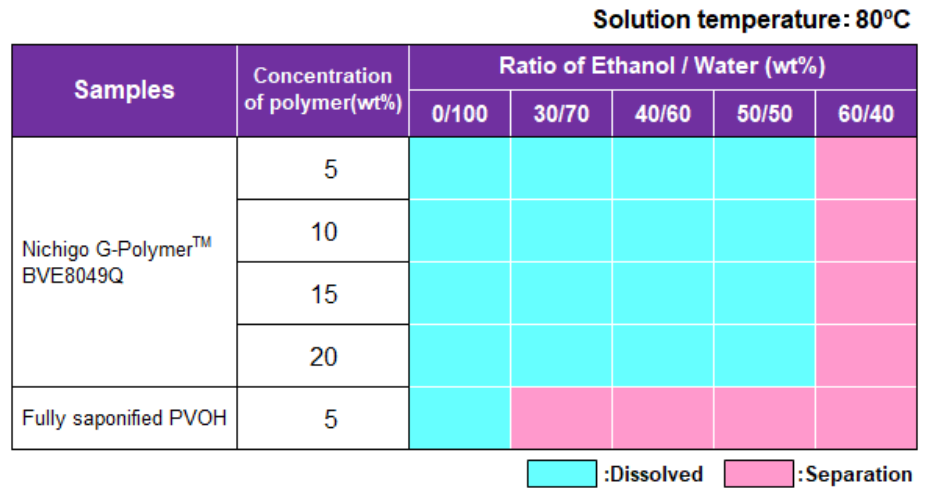
Alcohol tolerance
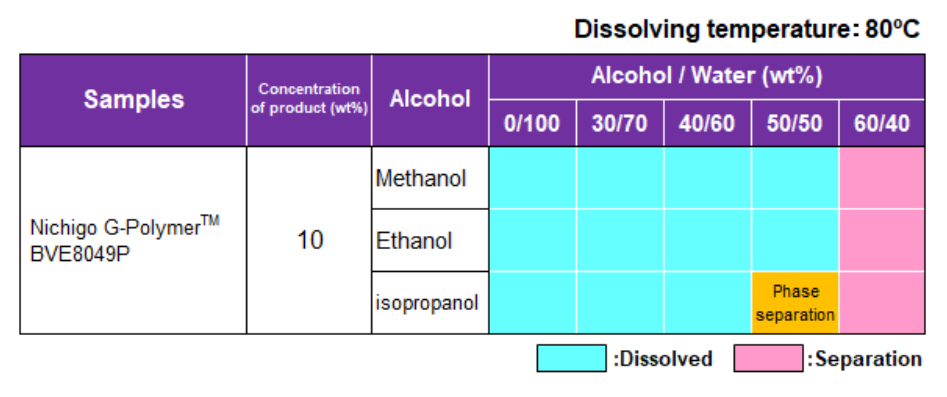
Nichigo G-Polymer™ also dissolves in aqueous solutions containing a large amount of lower alcohol.
Surface tension
Nichigo G-Polymer™ aqueous solution demonstrates high surface tension compared to PVOH.
Comparison of surface tension with PVOH
Surface tensions of Nichigo G-Polymer™ AZF8035Q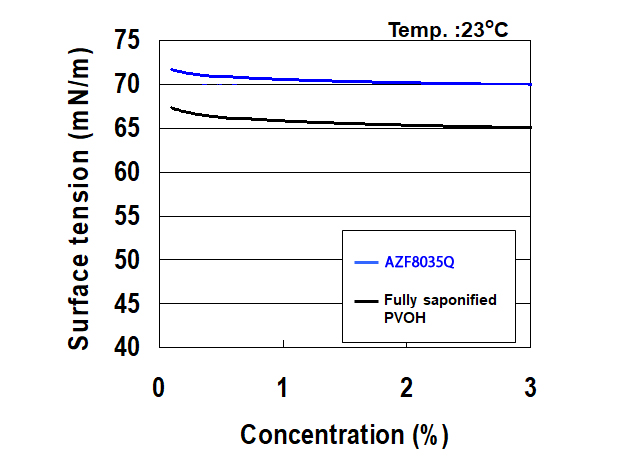



-scaled.jpg)