Semiconductor Materials
Polyvinyl Alcohol (PVOH) Materials for Semiconductor Front-End Processes
Challenges in Semiconductor Front-End Processes
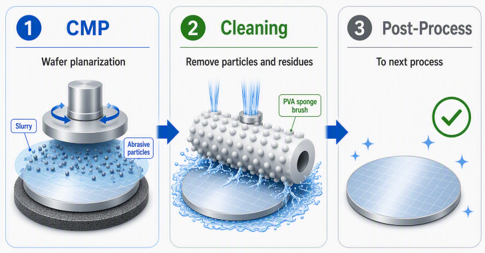
As semiconductor devices continue to become more advanced and miniaturized, increasingly stringent quality control is required in wafer planarization and cleaning processes. In CMP and cleaning operations, reducing scratches, particles, and residues is critical for process stabilization and yield improvement.
What is CMP Slurry?
CMP (Chemical Mechanical Polishing) is a technology that combines chemical and mechanical actions to planarize wafer surfaces. CMP slurries contain abrasives and functional additives, making not only polishing performance but also dispersion stability and cleanability important factors.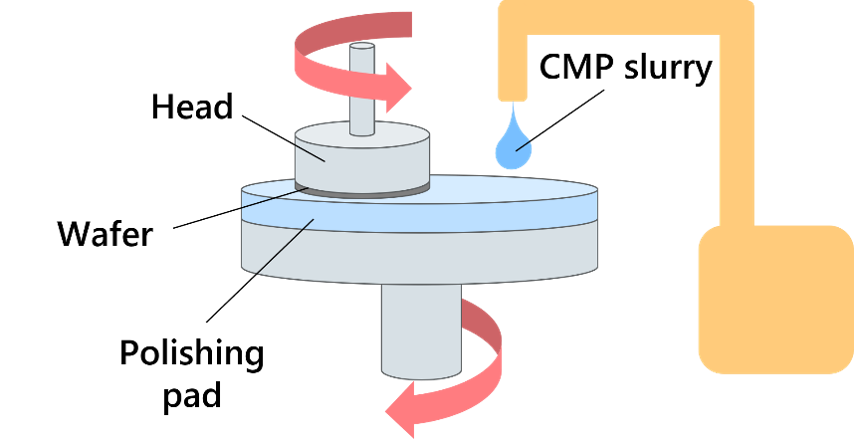
What is the Cleaning Process?
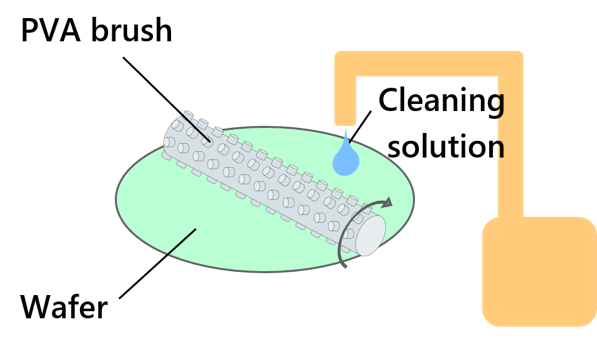
After CMP, residues such as abrasive particles and organic matter may remain on the wafer surface. The cleaning process is designed to efficiently remove these residues and suppress defect generation in subsequent processes. PVA brushes are widely used cleaning components in wafer cleaning processes.
Challenges Associated with Device Miniaturization
As semiconductor devices become increasingly miniaturized, even trace amounts of particles and residues may affect yield. Therefore, demand is growing for improved CMP slurry dispersion stability and defect reduction in cleaning processes.
PVOH Solutions Contributing to CMP and Cleaning Processes
Mitsubishi Chemical provides materials for CMP slurries and PVA brushes by leveraging its long-cultivated PVOH technology. By utilizing properties such as hydrophilicity, dispersibility, surface interaction, and water absorption, these materials contribute to solving challenges in semiconductor front-end processes.
For CMP Slurries (GOHSENX™ L, Nichigo G-Polymer™, GOHSENX™ K)
In CMP slurries, dispersion stability of abrasive particles and wettability control of wafer surfaces are important. GOHSENX™ L is an anionic PVOH containing sulfonic acid groups, and is expected to provide excellent dispersibility and protective colloid properties.
Nichigo G-Polymer™ is a butanediol-modified PVOH with high hydrophilicity, and is expected to be applicable for inorganic particle dispersion and surface hydrophilization applications.
Key Features
- Dispersion stability of abrasive particles
- Protective colloid properties
- Surface hydrophilization
Dispersion Design Through Surface Charge Control
Special modified PVOH can control the surface charge (zeta potential) of silica particles depending on the type of modified group. By adjusting electrostatic interactions between particles, these materials contribute to improving dispersion stability and slurry properties in CMP slurries. Cationic-modified PVOH (GOHSENX™ K) has been confirmed to impart a positive charge, while anionic PVOH (GOHSENX™ L) has been confirmed to impart a negative charge. Control of particle surface charge is expected to contribute to the optimization of dispersion stability and interparticle interactions.
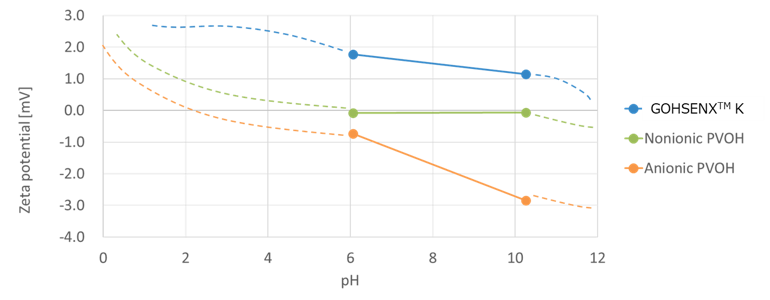
*Apparatus: Zeta-potential & Particle size Analyzer ELSZ-PLUS2 (Otsuka Electronics)
*Measured zeta potential of silica-dispersed PVOH aqueous solution
For Cleaning Brushes (GOHSENX™, Nichigo G-Polymer™)
PVA brushes are porous cleaning components used in post-CMP cleaning processes. By utilizing special modified PVOH such as GOHSENX™ and Nichigo G-Polymer™, it is possible to design characteristics such as water absorption, hardness, and surface charge, enabling compatibility with the various properties required in cleaning processes.
Key Features
- Water absorption control
- Hardness control
- Surface charge control